
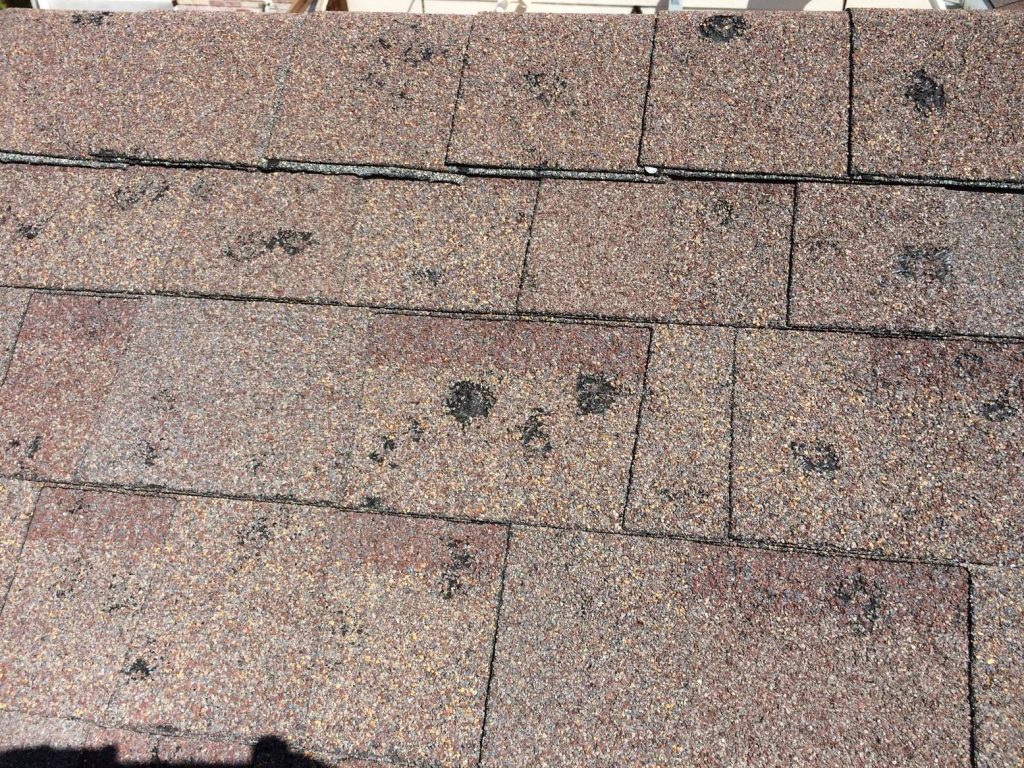
Hail events are among the most common and most underestimated causes of roof damage in the Southeast. A storm that passes in 20 minutes can leave behind damage that deteriorates a roofing system over the following 12 to 24 months — damage that homeowners may not recognize until interior leaks appear.
Understanding what hail damage looks like, how to get an accurate damage assessment, and how the insurance claim process works gives homeowners the tools to respond appropriately rather than reactively.
What Hail Damage Actually Does to Roofing
The impact of hailstones on roofing materials causes two types of damage: immediate visible damage and functional damage that becomes apparent over time.
On Asphalt Shingles
Hail impacts on asphalt shingles produce distinctive marks that trained inspectors can identify clearly. Key indicators:
Granule displacement. The impact of hail knocks granules off the shingle surface, exposing the underlying asphalt mat. These circular or irregular bare spots are visible on close inspection and appear as darkened areas in the granule field. When significant granule loss has occurred across a large portion of the roof, the shingles lose UV protection and begin aging rapidly.
Fractured or cracked mat. Larger hail or high-velocity impacts can fracture the fiberglass mat beneath the granule surface. This is the most significant type of shingle hail damage — a cracked mat creates a pathway for water infiltration that will worsen over time even if the granules above the crack appear intact.
Soft spots. On a properly inspected roof (from the surface, not the ground), hail impacts on asphalt shingles create soft spots — areas where the underlying mat has been compromised and feels spongy or malleable compared to the surrounding shingle field. Ground-level inspection cannot identify this type of damage.
Impact pattern matching storm trajectory. Genuine hail damage follows consistent patterns across a roof surface reflecting the direction and angle of the storm. Damage that appears random or concentrated only on certain faces may indicate other causes.
On Metal Roofing
Hail damage on metal roofing presents differently than on asphalt. Hail impacts on exposed fastener metal panels create visible dents in the panel surface. Standing seam and metal shingle products are more impact-resistant than corrugated or exposed fastener systems, and Class 4 rated metal roofing products may show minimal or no visible impact deformation from most residential hail events.
The concern with hail-damaged metal roofing is typically at paint and coating integrity rather than the metal substrate — significant hail impacts can crack or chip protective coatings, exposing underlying metal to corrosion.
On Gutters and Accessory Components
Hail damage is often most visible on soft metal components — gutters, downspouts, aluminum vents, and HVAC equipment housing. Dented gutters and downspouts provide visible, easily documented evidence of hail impact that supports roofing damage claims. If gutters show clear impact denting, adjacent roofing surfaces should be inspected for corresponding damage.
How to Determine If Your Roof Sustained Hail Damage
After a storm that included hail, several steps help determine whether your roof sustained significant damage.
Check soft metal components. Before calling a contractor, inspect accessible soft metal surfaces — gutters, window screens, window flashing, HVAC equipment — for visible denting. This gives you initial evidence of hail impact without requiring roof access.
Look for granule loss in gutters. After rain following a hail event, run water through gutters and check what comes out at the downspout. Significant granule accumulation indicates shingle surface impact.
Document the storm event. Note the date, time, and general characteristics of the storm (approximate hail size if observed, storm duration, direction). Weather records from official sources can confirm storm data for insurance purposes.
Get a professional inspection from a licensed roofing contractor. This is the most important step. A professional hail damage inspection involves walking the full roof surface, examining representative areas of each roof slope, and documenting observed damage with photographs and measurements. Ground-level observation cannot identify functional hail damage — the inspection must occur from the roof surface.
How to File an Insurance Claim for Hail Damage on Your Roof
Hail damage is a covered peril under most standard homeowner’s insurance policies — subject to your deductible and any coverage limitations specific to your policy.
Claim Timing
Most homeowner’s policies have statutes of limitation for storm damage claims — typically one to two years from the date of the weather event. Waiting too long to file eliminates your coverage rights.
However, the goal is not to file a claim immediately without an accurate damage assessment. Filing a claim that cannot be supported with documented damage creates friction with your insurer without benefit.
The right sequence: get a professional damage assessment first, determine whether damage is significant enough to exceed your deductible and warrant a claim, then file with documentation in hand.
Understanding Your Deductible
Many policies have separate wind and hail deductibles, often expressed as a percentage of the insured dwelling value. A 2% wind/hail deductible on a home insured for $350,000 is $7,000 — significantly higher than a standard $1,000 or $2,500 policy deductible. If your deductible is high relative to the repair cost, filing a claim may not be in your financial interest.
The Adjuster Inspection
When you file a claim, your insurer will send an adjuster to inspect the damage. Be present during the adjuster’s visit. Having a roofing contractor present — one who has already inspected the damage and documented their findings — ensures that all legitimate damage is observed and documented by the adjuster.
Adjuster inspections vary in thoroughness. Some adjusters walk every square foot of the roof carefully. Others assess representative areas. Having an advocate who can point to damage areas the adjuster might miss is often the difference between a full and partial claim settlement.
Contractor’s Role in the Claim Process
A legitimate roofing contractor helps you document damage accurately and ensures the claim scope reflects the actual damage to your roof. They do not inflate the claim beyond the actual damage, do not offer to waive your deductible (which is insurance fraud), and do not pressure you to file a claim when the damage is below your deductible threshold.
If a contractor’s involvement in your claim seems to be about generating business for themselves rather than accurately documenting your damage, find a different contractor.
Class 4 Impact-Rated Roofing: Reducing Future Hail Risk
If your roof requires replacement following a hail event, this is an opportunity to consider Class 4 impact-rated roofing products that will better resist future hail damage.
Class 4 is the highest rating under the UL 2218 standard for impact resistance. Products carrying this designation have been tested by firing 2-inch steel balls at the shingle surface at speeds that simulate large hail and shown no cracking or failure of the protective granule layer.
In many markets with active hail seasons — which includes significant portions of both Carolinas — insurers offer premium discounts for Class 4 rated roofing. These discounts, which can reach 20 to 30 percent of annual premium in some cases, can meaningfully offset the cost premium for impact-rated products over standard architectural shingles.
After Hail Damage: Timeline for Resolution
Hail damage claims and associated repairs take time. A realistic timeline:
Days 1-3: Document damage, contact insurer to open claim, schedule professional damage assessment from licensed contractor.
Days 3-10: Adjuster inspection. Professional contractor inspection if not already complete. Obtain written damage assessment and repair estimate.
Days 10-21: Insurance claim processing and settlement offer. Review settlement offer against contractor estimate. Address any discrepancies with carrier.
Weeks 3-8: Roof repair or replacement scheduled and executed (timelines extended after widespread area damage events when demand exceeds local contractor capacity).
Related Reading: Storm Damage: Immediate Steps After a Severe Weather Event | How to Vet Roof Repair Contractors Near You
External Resource: UL 2218 Impact Resistance Testing — Insurance Institute for Business and Home Safety